
Triplex Mud Pump — API 7K Certified, F Series / P Series / NB Series
350HP–2200HP • Single Acting Triplex • API 7K Standard • Forced + Splash Lubrication • 100% Interchangeable Spare Parts
Product Overview
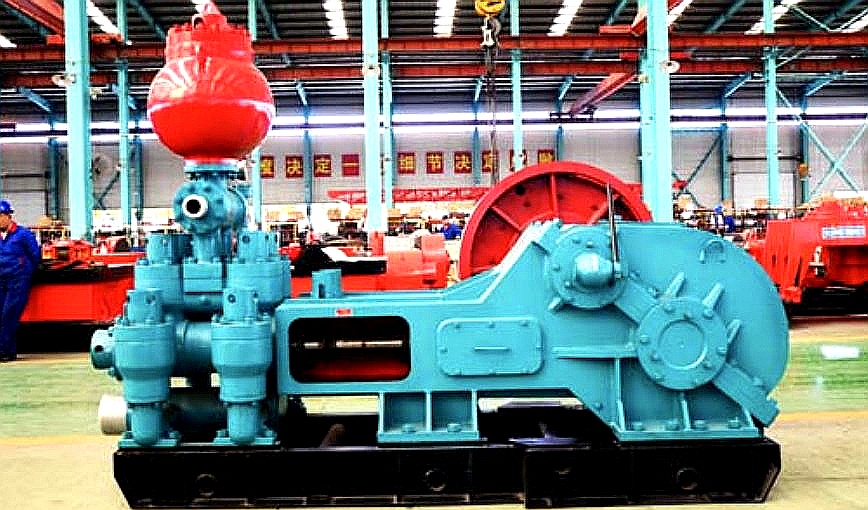
DEENPU API 7K Triplex Mud Pump — F-1600 Series with Power End, Fluid End, and Pulsation Dampener
DEENPU Triplex Mud Pump is a high-performance, single-acting, triplex reciprocating pump designed and manufactured in strict accordance with API 7K specification. It is the heart of the drilling rig circulation system, responsible for pumping drilling fluid (mud) at high pressure down the drill string and back up the annulus, carrying cuttings to the surface, cooling the drill bit, and maintaining hydrostatic pressure in the wellbore.
DEENPU offers a comprehensive range of mud pumps covering 350 HP to 2,200 HP, including the industry-standard F Series (F-500, F-800, F-1000, F-1300, F-1600), P Series (8P-80, 9P-100, 10P-130, 12P-160), NB Series (3NB350, 3NB-500C, 3NB-800C, 3NB-1000C, 3NB-1300C, 3NB-1600), and TWS Series (TWS600S, TWS2000). All pumps feature a robust power end with combined forced lubrication and splash lubrication systems, a high-pressure fluid end with replaceable liners and pistons, and a pulsation dampener system to minimize pressure fluctuations.
All DEENPU mud pumps are supplied with 100% API-interchangeable spare parts including liners, pistons, valves, seats, springs, and modules. We also provide mud pump liners and a complete range of interchangeable spare parts manufactured to OEM specifications. Every pump is delivered with full inspection reports, material certificates, and hydrostatic test documentation.
Technical Drawings
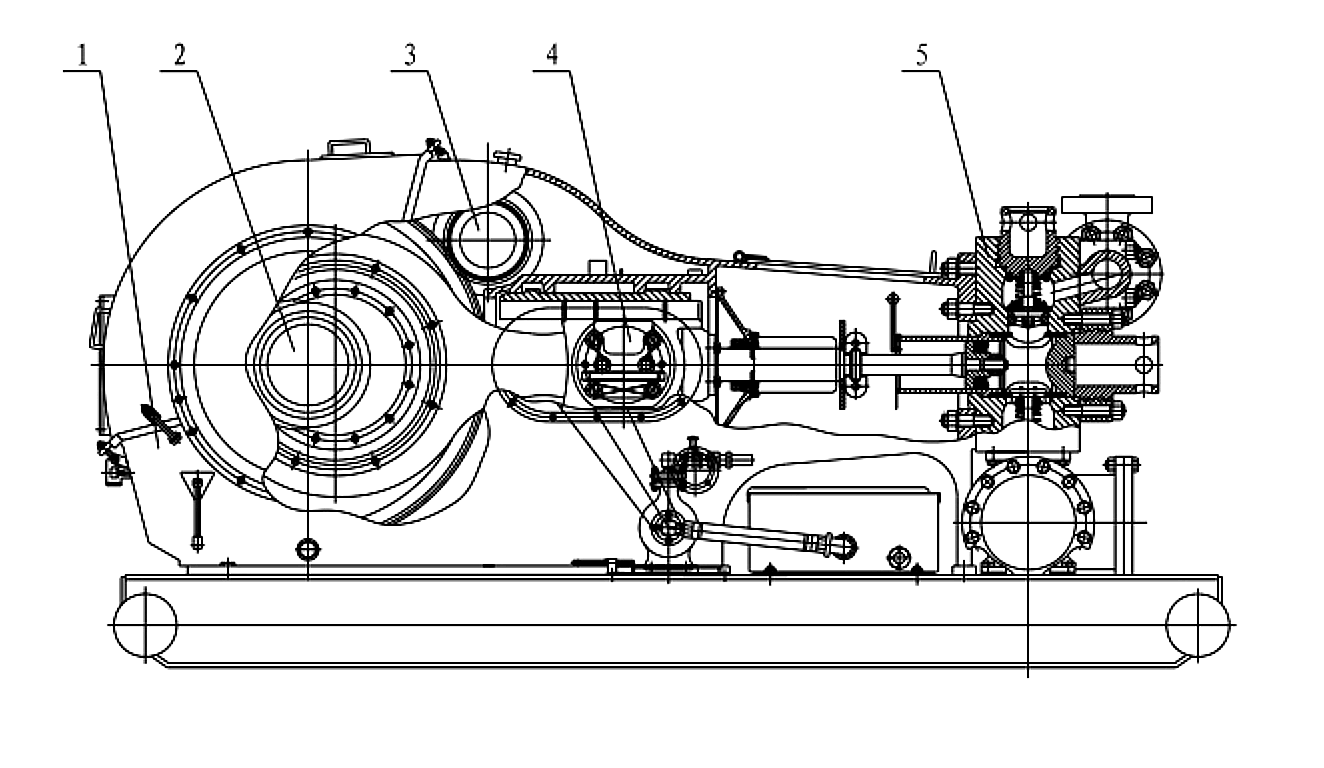
DEENPU Mud Pump Side View — Power End Crankshaft Assembly and Fluid End Cross-Section
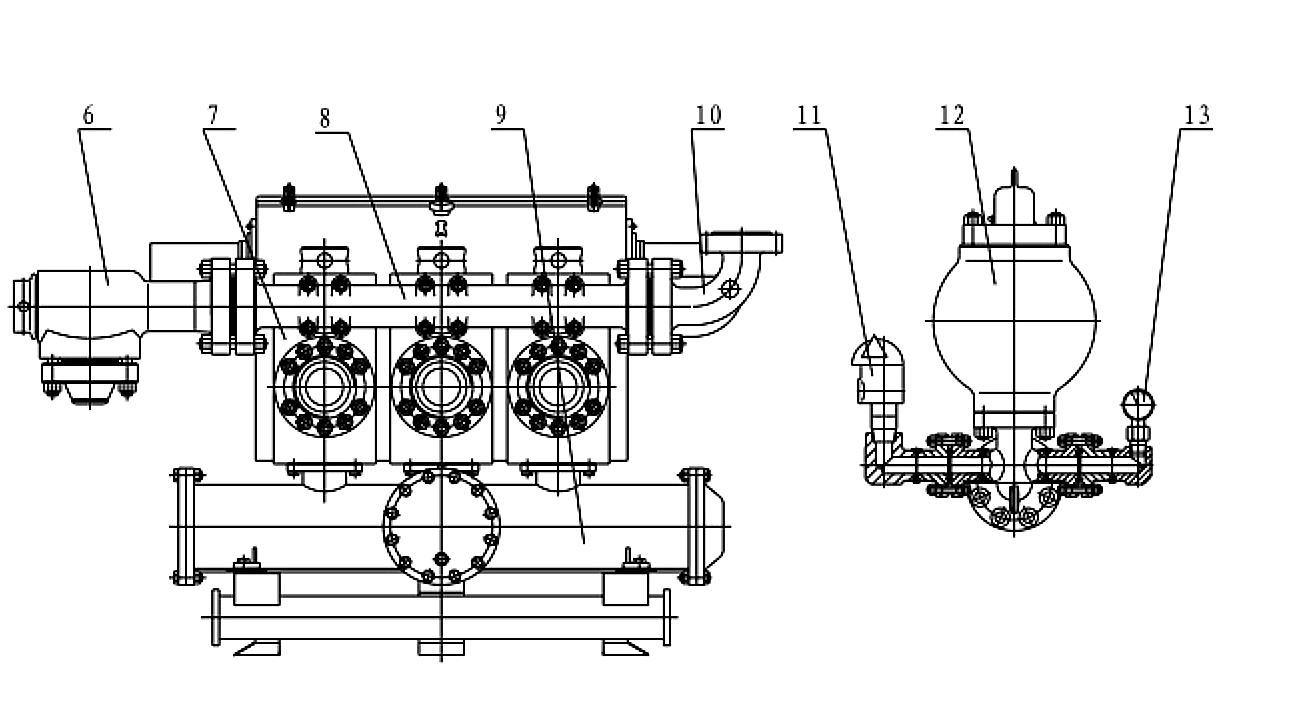
DEENPU Mud Pump Front View & Pulsation Dampener Assembly — Three-Cylinder Fluid End and Air Bladder Dampener
The technical drawings above illustrate the key assemblies of the DEENPU triplex mud pump. The power end (left side) contains the crankshaft, connecting rods, crossheads, and gearbox, driven by an electric motor or diesel engine through a belt or chain drive. The fluid end (right side) contains the three cylinder bores, each fitted with a replaceable liner and piston, suction valves, and discharge valves. The pulsation dampener (top right) is a pre-charged air bladder system that absorbs pressure pulses from the triplex pump, smoothing the discharge flow and reducing vibration in the discharge line. The combination of forced lubrication (for bearings and gears) and splash lubrication (for crosshead slides) ensures reliable operation under the most demanding drilling conditions.
How the Mud Pump Works
The triplex mud pump is a positive-displacement reciprocating pump that performs three critical functions in the drilling circulation system:
- Drilling Fluid Circulation — The pump draws drilling fluid from the mud pits through the suction manifold and into the three cylinders. As the pistons reciprocate (driven by the crankshaft through connecting rods), the fluid is compressed and discharged through the discharge valves into the discharge manifold at high pressure. The high-pressure fluid flows through the standpipe, rotary hose, swivel, and down the drill string to the bit, where it exits through nozzles to cool the bit and carry cuttings. The fluid then returns up the annulus to the surface, where it is cleaned by the shale shaker, desander, and desilter before returning to the mud pits. The pump must continuously circulate this fluid at a rate sufficient to maintain adequate annular velocity for cuttings transport and to provide sufficient hydrostatic pressure to prevent formation fluid influx.
- Pressure Generation for Bit Hydraulics — The pump generates the high pressure required for the drilling fluid to pass through the restricted nozzles in the drill bit. This pressure drop across the bit nozzles creates the jet velocity that cleans the bit face and the bottom of the hole, improving penetration rate. The pump pressure must also overcome the friction losses in the drill string, the annulus, and the surface piping. DEENPU mud pumps are designed to deliver pressures up to 5,000 PSI (35 MPa) depending on the model and liner size, with adjustable flow rates achieved by changing the liner and piston diameter. Smaller liners produce higher pressure but lower flow rate; larger liners produce higher flow rate but lower pressure.
- Pulsation Dampening for System Protection — A triplex pump produces a pulsating flow because each of the three cylinders discharges at a different phase of the crankshaft rotation. This pulsation creates pressure spikes and vibrations that can damage the discharge line, swivel, and surface equipment. The pulsation dampener is a pre-charged air bladder or nitrogen-charged vessel installed on the discharge manifold. It absorbs the pressure spikes during the pump discharge stroke and releases fluid during the suction stroke, smoothing the flow to within 3-5% of the average pressure. The dampener is pre-charged to 60-70% of the average discharge pressure and must be maintained at the correct charge pressure for optimal performance. The dampener also reduces vibration in the pump power end, extending bearing and crosshead life.
Key Features
Applications
- Oil and gas well drilling — Primary mud circulation for land and offshore drilling rigs from 1,000 HP to 3,000 HP
- Water well drilling — High-pressure mud and water circulation for deep water well drilling operations
- Geothermal drilling — High-temperature drilling fluid circulation for geothermal well construction
- Well cementing operations — Pumping cement slurry at high pressure for primary and secondary cementing jobs
- Hydraulic fracturing — High-pressure fluid pumping for fracturing and stimulation operations (with appropriate liner and piston upgrades)
- Workover and well servicing — Mud circulation, well killing, and stimulation fluid pumping during workover operations
- Horizontal and directional drilling — High-flow-rate mud circulation for extended-reach and horizontal well drilling
- Deep and ultra-deep drilling — F-1300 and F-1600 models for 7,000m+ depth drilling with high-pressure requirements
Technical Specifications — F Series
| Model | Rated Power (HP / kW) |
Stroke Length (mm / in) |
Max Stroke Rate (SPM) |
Liner Sizes (mm / in) |
Max Pressure (MPa / PSI) |
Max Flow Rate (L/min / GPM) |
Weight (kg / lb) |
|---|---|---|---|---|---|---|---|
| F-500 | 500 / 373 | 190 / 7.5 | 165 | 90-150 / 3.5-5.9 | 34.5 / 5,000 | 1,670 / 441 | 9,800 / 21,600 |
| F-800 | 800 / 597 | 210 / 8.25 | 150 | 100-170 / 3.9-6.7 | 34.5 / 5,000 | 2,420 / 639 | 14,500 / 32,000 |
| F-1000 | 1,000 / 746 | 210 / 8.25 | 140 | 100-170 / 3.9-6.7 | 34.5 / 5,000 | 2,760 / 729 | 16,200 / 35,700 |
| F-1300 | 1,300 / 970 | 230 / 9.05 | 120 | 110-180 / 4.3-7.1 | 34.5 / 5,000 | 3,480 / 919 | 22,000 / 48,500 |
| F-1600 | 1,600 / 1,193 | 230 / 9.05 | 120 | 120-190 / 4.7-7.5 | 34.5 / 5,000 | 4,280 / 1,130 | 26,500 / 58,400 |
F Series: Single-acting triplex mud pump with one-piece cast steel frame. Combined forced and splash lubrication. Forged alloy steel crankshaft. Replaceable bi-metal liners and polyurethane pistons standard. Pressure and flow vary with liner size selection. Contact us for detailed performance curves and liner selection charts.
Technical Specifications — P Series
| Model | Rated Power (HP / kW) |
Stroke Length (mm / in) |
Max Stroke Rate (SPM) |
Liner Sizes (mm / in) |
Max Pressure (MPa / PSI) |
Max Flow Rate (L/min / GPM) |
|---|---|---|---|---|---|---|
| 8P-80 | 350 / 261 | 160 / 6.3 | 180 | 80-130 / 3.1-5.1 | 31 / 4,500 | 1,200 / 317 |
| 9P-100 | 500 / 373 | 180 / 7.1 | 170 | 90-140 / 3.5-5.5 | 31 / 4,500 | 1,600 / 423 |
| 10P-130 | 750 / 559 | 200 / 7.9 | 160 | 100-160 / 3.9-6.3 | 31 / 4,500 | 2,200 / 581 |
| 12P-160 | 1,000 / 746 | 220 / 8.7 | 150 | 110-170 / 4.3-6.7 | 31 / 4,500 | 2,900 / 766 |
P Series: Compact triplex mud pump with modular design. Popular for workover rigs and smaller drilling operations. 100% interchangeable with industry-standard P series components. Forced lubrication system with oil cooler.
Technical Specifications — NB Series
| Model | Rated Power (HP / kW) |
Stroke Length (mm / in) |
Max Stroke Rate (SPM) |
Liner Sizes (mm / in) |
Max Pressure (MPa / PSI) |
Max Flow Rate (L/min / GPM) |
|---|---|---|---|---|---|---|
| 3NB-350 | 350 / 261 | 150 / 5.9 | 190 | 80-120 / 3.1-4.7 | 31 / 4,500 | 1,100 / 291 |
| 3NB-500C | 500 / 373 | 170 / 6.7 | 180 | 90-140 / 3.5-5.5 | 31 / 4,500 | 1,500 / 396 |
| 3NB-800C | 800 / 597 | 195 / 7.7 | 160 | 100-160 / 3.9-6.3 | 31 / 4,500 | 2,300 / 607 |
| 3NB-1000C | 1,000 / 746 | 210 / 8.25 | 150 | 100-170 / 3.9-6.7 | 31 / 4,500 | 2,800 / 740 |
| 3NB-1300C | 1,300 / 970 | 230 / 9.05 | 140 | 110-180 / 4.3-7.1 | 34.5 / 5,000 | 3,500 / 925 |
| 3NB-1600 | 1,600 / 1,193 | 230 / 9.05 | 140 | 120-190 / 4.7-7.5 | 34.5 / 5,000 | 4,200 / 1,109 |
NB Series: Compact and lightweight design with high power-to-weight ratio. Popular for Chinese drilling rigs and export markets. Forced lubrication with splash backup. Replaceable liners and pistons. 100% interchangeable with OEM NB series components.
Technical Specifications — TWS Series
| Model | Rated Power (HP / kW) |
Stroke Length (mm / in) |
Max Stroke Rate (SPM) |
Liner Sizes (mm / in) |
Max Pressure (MPa / PSI) |
Max Flow Rate (L/min / GPM) |
|---|---|---|---|---|---|---|
| TWS600S | 600 / 447 | 200 / 7.9 | 165 | 100-160 / 3.9-6.3 | 31 / 4,500 | 2,000 / 528 |
| TWS2000 | 2,200 / 1,641 | 250 / 9.84 | 120 | 130-210 / 5.1-8.3 | 34.5 / 5,000 | 5,500 / 1,453 |
TWS Series: Heavy-duty and ultra-heavy-duty mud pumps. TWS2000 is the most powerful pump in the DEENPU range, designed for ultra-deep drilling and high-flow-rate applications. Reinforced power end with larger bearings and thicker frame.
When Ordering, Please Specify
- Pump Model and SeriesF Series (F-500, F-800, F-1000, F-1300, F-1600), P Series (8P-80, 9P-100, 10P-130, 12P-160), NB Series (3NB-350 to 3NB-1600), or TWS Series (TWS600S, TWS2000).
- Rated Power and SpeedRated input power (HP or kW). Maximum stroke rate (SPM) required for the drilling program.
- Liner and Piston ConfigurationLiner inner diameter (determines pressure and flow rate). Piston type (polyurethane, rubber, or ceramic). Liner material (bi-metal, ceramic, or hardened steel).
- Pressure and Flow RequirementsMaximum operating pressure (MPa or PSI). Required flow rate (L/min or GPM) at operating pressure. Specify if variable flow is needed for different drilling phases.
- Drive ConfigurationElectric motor drive (specify voltage, frequency, and motor type). Diesel engine drive (specify engine model and power rating). Belt drive or chain drive. Gear reducer ratio if applicable.
- Valve TypeAPI 7# valve and seat (standard). Full-open valve for high-flow applications. Double-diameter valve for deep well drilling.
- Relief ValveShear relief valve (one-time use, ruptures at set pressure). Reset relief valve (automatically reseats after overpressure event). Specify set pressure.
- Pulsation DampenerAir-charged bladder type or nitrogen-charged type. Dampener volume (standard or oversized). Pre-charge pressure requirement.
- Fluid End Module ConfigurationStandard fluid end or high-pressure fluid end (for 5,000+ PSI). Suction manifold size and flange type. Discharge manifold size and flange type (API or ANSI).
- Certification and DocumentationAPI 7K certification, material test certificates, hydrostatic test certificates, performance test curves, and third-party inspection (DNV, BV, SGS).
Custom Manufacturing & OEM Capability
- Custom Power Ratings — Pumps engineered for non-standard power ratings (e.g., 1,200 HP, 1,800 HP) to match specific rig requirements.
- High-Pressure Fluid End — Fluid end modules rated to 7,500 PSI (52 MPa) or 10,000 PSI (70 MPa) for ultra-deep drilling and fracturing applications.
- Special Liner Materials — Ceramic liners for abrasive formations, chrome-plated liners for extended wear life, and zirconia liners for extreme abrasion resistance.
- Piston Material Options — Polyurethane (standard), nitrile rubber, HNBR, FKM, or ceramic-coated pistons for high-temperature and chemical-resistant applications.
- Extended Frame and Stroke — Custom stroke lengths and frame configurations for ultra-high-flow or ultra-high-pressure applications.
- Skid and Base Mounting — Custom skid-mounted packages with integrated motor base, belt guard, and vibration isolation system.
- PLC Control System — Siemens, Allen-Bradley, or Schneider PLC control cabinet with automated pump control, overload protection, and remote monitoring.
- Complete Package — Pump, motor, gearbox, pulsation dampener, relief valve, suction stabilizer, and instrumentation supplied as a complete ready-to-install package.
Quality Control & Testing Standards
- Frame and power end magnetic particle inspection (MPI) and ultrasonic testing (UT) on all castings and forgings.
- Crankshaft full NDT inspection including ultrasonic and magnetic particle testing. Surface hardness and dimensional verification.
- Fluid end modules hydrostatically tested to 1.5x rated working pressure. Pressure hold test with zero leakage verification.
- Liner and piston surface finish and dimensional inspection to API 7K tolerances. Hardness testing on liner inner surface.
- Valve and seat leak test and flow test at rated pressure. Spring rate and closing pressure verification.
- Complete pump performance test at factory: flow rate, pressure, power consumption, and mechanical efficiency measured at multiple speed and load points.
- Power end lubrication system test: oil pressure, flow rate, and temperature monitored under operating conditions.
- Pulsation dampener pre-charge verification and pressure hold test before shipment.
- Material test certificates (MTC) per EN 10204 3.1 provided for all pressure-bearing and structural components.
- Third-party inspection and certification by DNV, BV, SGS, or ABS available upon request.
Frequently Asked Questions
What is the difference between single-acting and double-acting mud pumps?
A single-acting mud pump displaces fluid only on the forward (power) stroke of the piston; the suction stroke is used only to draw fluid into the cylinder. A double-acting pump displaces fluid on both the forward and return strokes, effectively doubling the flow rate for the same piston size and stroke rate. However, double-acting pumps are more complex and are rarely used in drilling applications. Triplex single-acting pumps (three cylinders, each single-acting) are the industry standard for drilling because they provide a relatively smooth flow (compared to duplex pumps), are simpler and more reliable, and are easier to maintain. The three cylinders are phased 120 degrees apart on the crankshaft, providing six discharge pulses per revolution, which is smooth enough for most drilling operations when combined with a pulsation dampener.
How do I select the right liner size for my drilling program?
Liner size selection is based on the flow rate and pressure required for your drilling program. The basic principle is: smaller liners = higher pressure, lower flow rate; larger liners = lower pressure, higher flow rate. For a given pump model and speed, the pressure is inversely proportional to the square of the liner diameter, and the flow rate is proportional to the square of the liner diameter. To select the correct liner: (1) Calculate the required flow rate based on annular velocity (typically 100-150 ft/min) and hole geometry. (2) Calculate the required pressure based on bit hydraulics, annular friction, and surface losses. (3) Select the largest liner that can deliver the required flow rate at or below the required pressure. (4) Verify that the pump power is sufficient (Power = Pressure x Flow Rate / Efficiency). DEENPU provides detailed performance curves for each pump model showing pressure vs. flow rate for each liner size. Contact our engineering team for liner selection assistance.
What is the difference between a shear relief valve and a reset relief valve?
A shear relief valve protects the pump by rupturing a shear pin or disc when the discharge pressure exceeds the set pressure. Once the shear pin ruptures, the valve opens and the pump discharges to the suction pit or atmosphere, relieving the overpressure. The shear pin must be replaced after activation, and the pump must be shut down for maintenance. Shear relief valves are simpler, more reliable, and less expensive. They are commonly used on smaller pumps and in applications where overpressure events are rare. A reset relief valve (also called a pop-off or spring-loaded relief valve) opens when the pressure exceeds the set pressure and automatically reseats when the pressure drops below the set pressure. It can be reset without shutdown and does not require replacement of parts after activation. Reset relief valves are preferred for larger pumps, continuous drilling operations, and applications where temporary pressure spikes are common (e.g., when drilling through tight formations). DEENPU offers both types and can recommend the best option based on your drilling program.
How often should I change the liners and pistons?
Liner and piston life depends on the drilling conditions, mud properties, and operating hours. Typical liner life: 500-1,500 hours for bi-metal liners in normal drilling; 200-500 hours in abrasive formations (sandstone, conglomerate). Typical piston life: 300-800 hours for polyurethane pistons; 100-300 hours in abrasive conditions. Replace liners when: the inner diameter has worn beyond the maximum allowable tolerance (typically 0.5-1.0 mm oversize); the liner surface shows scoring, galling, or cracks; or the pump cannot maintain pressure at the required flow rate. Replace pistons when: the rubber or polyurethane shows tearing, chunking, or excessive wear; the piston diameter has worn below the seal threshold; or the piston shows cracks or delamination. DEENPU recommends inspecting liners and pistons every 250 operating hours and measuring liner ID with an internal micrometer. Keeping spare liners and pistons on the rig is essential to minimize downtime.
What is the correct pre-charge pressure for the pulsation dampener?
The correct pre-charge pressure for a bladder-type pulsation dampener is typically 60-70% of the average discharge pressure. For example, if the pump is operating at 3,000 PSI average discharge pressure, the dampener should be pre-charged to 1,800-2,100 PSI. The pre-charge pressure should never exceed the minimum operating pressure, or the dampener will not function. The pre-charge pressure should be checked daily with a pressure gauge and recharged if it drops below 60% of the operating pressure. The dampener should be charged with nitrogen (preferred) or clean dry air. Oxygen or combustible gases must never be used. A properly charged dampener will reduce pressure pulsation to 3-5% of the average pressure and significantly extend the life of the discharge line, swivel, and pump bearings. If the dampener is not charged, the pump will produce severe pressure pulsation (15-25% of average pressure), causing vibration, noise, and premature failure of downstream equipment.
What certifications do your mud pumps carry?
DEENPU mud pumps are designed and manufactured in accordance with API 7K (Specification for Drilling and Well Servicing Equipment). Each pump is supplied with a comprehensive documentation package including: material test certificates (MTC) for all pressure-bearing components, hydrostatic test certificates for the fluid end, performance test curves (flow rate vs. pressure at multiple speeds), power end lubrication system test report, NDT reports (MPI/UT) for frame and crankshaft, and dimensional inspection reports. The pump frame, fluid end, and major components are marked with heat numbers and serial numbers for full traceability. All liners, pistons, valves, and seats are manufactured to API 7K dimensions and are 100% interchangeable with OEM and industry-standard parts. Third-party inspection and certification by DNV, BV, SGS, or ABS is available on request for projects requiring classification society approval or customer-specific quality assurance protocols.
Request a Quote — Triplex Mud Pump
Send your drilling program specifications and we will recommend the optimal pump model, liner size, and configuration with a complete proposal including pricing, performance curves, and delivery schedule within 48 hours.
- EMAILSALES@DEENPU-MACHINERY.COM
- WHATSAPP+86-15806284962
- RESPONSEQuotation within 48 hours
Include: Hole size, drilling depth, mud type, required flow rate, maximum pressure, pump model preference, drive type, and certification requirements.
About Us
 Our company has been in the oil & gas drilling equipment industry for over more years, We are here to serve all your drilling equipment needs.