
Drilling Wire Rope — API 9A / ISO 10425 Standard, High Tensile Strength
IPS / EIPS / EEIPS Grade • 6x19S IWRC • 16mm–44mm Diameter • 1570–1960 MPa Tensile Strength • API 9A Certified
Product Overview
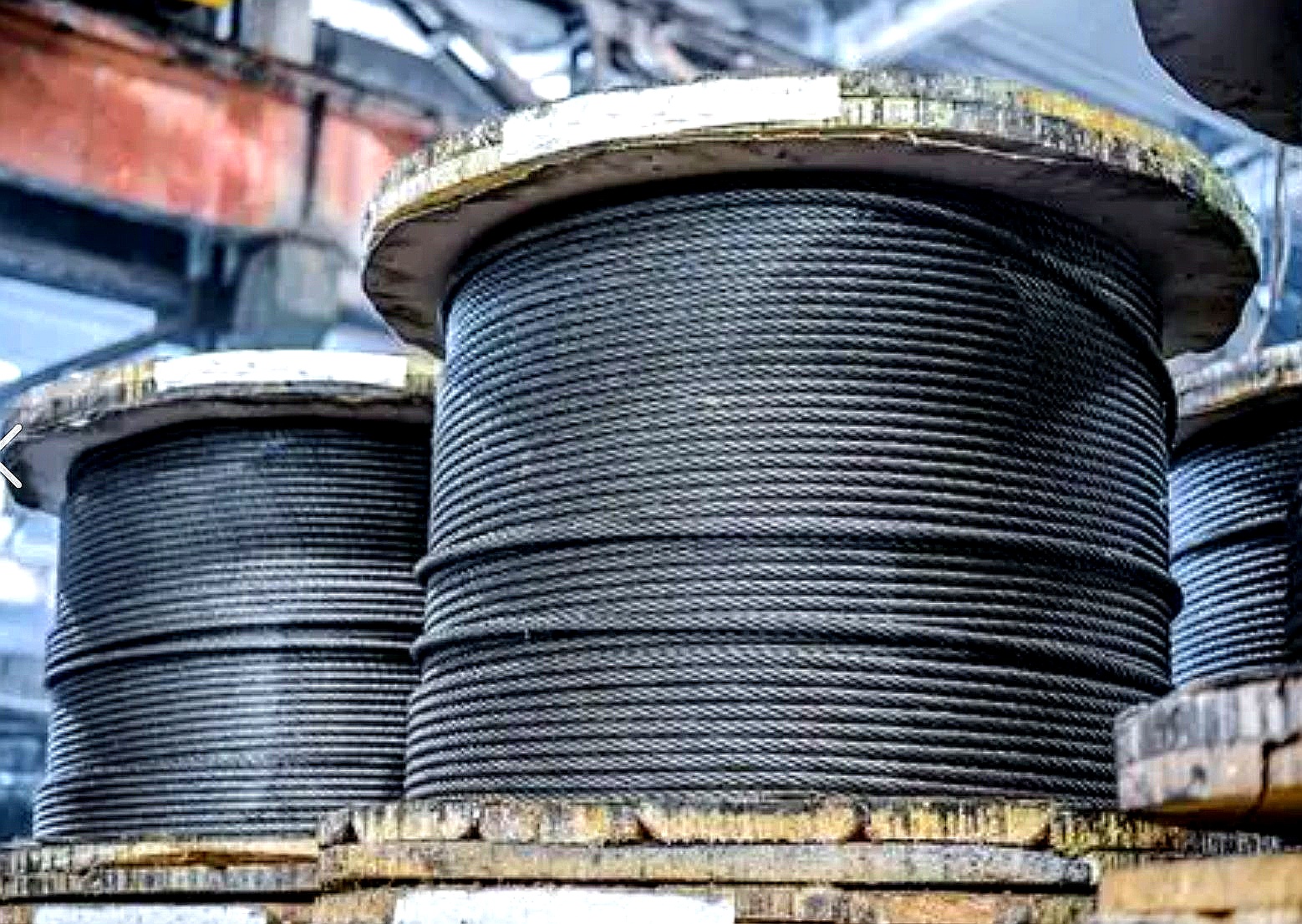
DEENPU API 9A / ISO 10425 Drilling Wire Rope on Industrial Spools — Ready for Rig Delivery
DEENPU Drilling Wire Rope is a high-performance steel wire rope manufactured to API 9A and ISO 10425 standards for use in drilling rig hoisting operations, workover drilling, and oilfield lifting applications. The rope is constructed from high-strength steel wires twisted around a central core, providing exceptional breaking force, smooth surface finish, and extended service life in the demanding conditions of oil and gas drilling operations.
Available in IPS (Improved Plow Steel), EIPS (Extra Improved Plow Steel), and EEIPS (Extra Extra Improved Plow Steel) material grades, with tensile strength classes from 1570 MPa to 1960 MPa. DEENPU wire rope is offered in both fiber core (FC) and independent wire rope core (IWRC) configurations, with diameters ranging from 16 mm to 44 mm. The most common drilling line construction is 6x19S IWRC, with diameters from 22 mm to 30 mm, selected according to the rig hook load requirements.
All DEENPU wire ropes feature a high metal filling factor for maximum breaking strength, smooth surface for reduced wear on sheaves and drums, and excellent anti-extrusion performance for stability under load. The rope is suitable for left-hand and right-hand lay configurations, with both regular and lang lay options available to match specific drum and sheave requirements.
Wire Rope Constructions & Cross-Sections
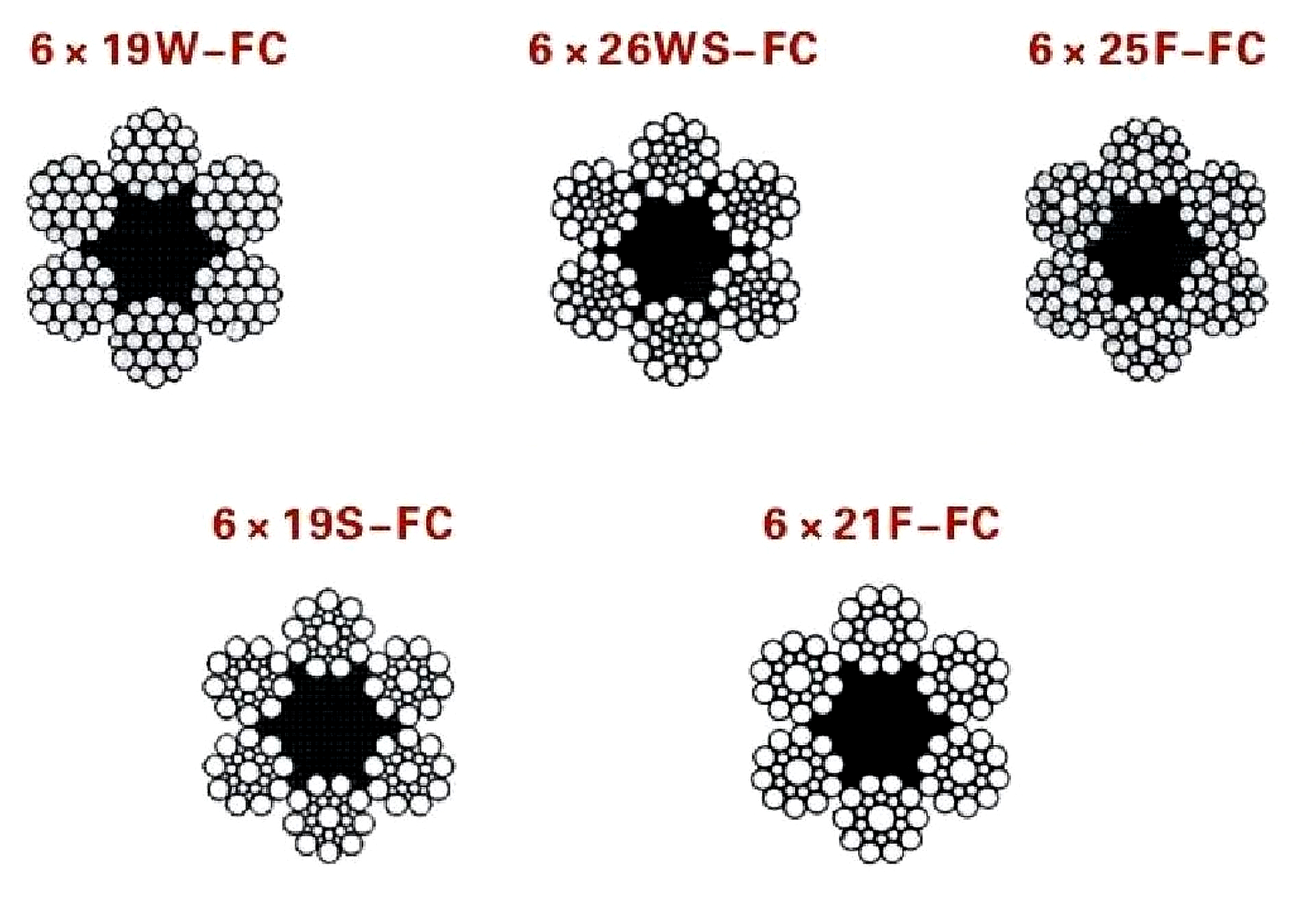
DEENPU Wire Rope Construction Cross-Sections — 6x19W, 6x26WS, 6x25F, 6x19S, and 6x21F Configurations
Wire rope construction refers to the number of strands, the number of wires per strand, and the arrangement of wires within each strand. The cross-section diagrams above illustrate the most common constructions used in oilfield drilling and hoisting applications:
How Wire Rope Works in Drilling Operations
Wire rope is the critical load-bearing element in the drilling rig hoisting system, performing three essential functions:
- Hoisting & Lowering the Drill String — The drilling line (typically 6x19S IWRC, 22-30 mm diameter) is reeved through the crown block and traveling block to create a multi-part hoist system. The wire rope transmits the pulling force from the drawworks drum to the traveling block, raising and lowering the drill string, casing, and bottom hole assembly. The rope must withstand dynamic loads from acceleration and deceleration, shock loading from stuck pipe, and the static weight of the entire drill string suspended in the derrick.
- Rotation Resistance & Stability — In a multi-part reeving system, the wire rope is subject to both tensile loading and rotational torque from the twist induced by the drum and sheaves. Properly selected rope construction (6x19S, 6x26WS, or 9x19S for drilling lines) maintains structural stability under load, preventing kinking, bird-caging, and core extrusion. The IWRC core provides crush resistance and prevents the outer strands from collapsing into the core under heavy loads.
- Wear Resistance & Fatigue Life — The wire rope passes over multiple sheaves and wraps around the drawworks drum during every trip. Each bend cycle causes internal wire fatigue. The Seale construction (6x19S) provides a large outer wire surface that distributes wear across the rope exterior, while the IWRC core resists the crushing forces from multi-layer drum spooling. DEENPU wire ropes are manufactured with smooth surface finish to minimize abrasion on sheave grooves and extend rope life by 20-30% compared to standard commercial rope.
Key Features
Applications
- Drilling rig hoisting lines — 6x19S IWRC drilling line for land and offshore drilling rigs, reeved through crown block and traveling block
- Workover and service rig operations — 9x19S and 8x19S constructions for workover units requiring higher flexibility and smaller sheaves
- Casing running and completion — 18×19 and 34×7 non-rotating constructions for single-part hoisting and casing running operations
- Well servicing and snubbing — High-flexibility multi-strand ropes for coiled tubing units, snubbing units, and service rigs
- Offshore crane and platform lifting — 6x36WS and 6x41WS constructions for platform cranes and offshore lifting operations
- Mooring and anchoring — 6×37 and 6×61 constructions with galvanized coating for offshore platform mooring systems
- Drawworks and winch lines — 6x19S and 6x26WS for drawworks drum spooling and auxiliary winch applications
- Elevator links and small-diameter hoisting — 8x19S FC for elevator sling links and small-diameter lifting applications
Technical Specifications — Breaking Force by Diameter
| Diameter (mm) |
Approx. Mass Kg/100m |
1570 MPa Min. Breaking Force (kN) |
1670 MPa Min. Breaking Force (kN) |
1770 MPa Min. Breaking Force (kN) |
1870 MPa Min. Breaking Force (kN) |
1960 MPa Min. Breaking Force (kN) |
||||||
|---|---|---|---|---|---|---|---|---|---|---|---|---|
| FC | IWRC | FC | IWRC | FC | IWRC | FC | IWRC | FC | IWRC | |||
| 16 | 109 | 118 | 150 | 166 | 159 | 176 | 169 | 187 | 179 | 197 | 187 | 207 |
| 18 | 138 | 150 | 190 | 210 | 202 | 223 | 214 | 236 | 226 | 250 | 237 | 261 |
| 20 | 170 | 185 | 234 | 259 | 249 | 275 | 264 | 292 | 279 | 308 | 292 | 323 |
| 22 | 206 | 224 | 283 | 314 | 301 | 333 | 320 | 353 | 338 | 373 | 354 | 391 |
| 24 | 245 | 266 | 337 | 373 | 359 | 396 | 380 | 420 | 402 | 444 | 421 | 465 |
| 26 | 287 | 312 | 395 | 438 | 421 | 465 | 446 | 493 | 472 | 521 | 494 | 546 |
| 28 | 333 | 362 | 458 | 507 | 487 | 538 | 516 | 570 | 546 | 603 | 572 | 632 |
| 30 | 382 | 415 | 526 | 583 | 560 | 619 | 594 | 656 | 629 | 694 | 659 | 727 |
| 32 | 435 | 473 | 598 | 663 | 637 | 704 | 676 | 746 | 715 | 789 | 749 | 827 |
| 34 | 491 | 534 | 676 | 748 | 719 | 795 | 763 | 842 | 807 | 891 | 847 | 935 |
| 36 | 550 | 599 | 757 | 838 | 805 | 891 | 855 | 943 | 904 | 998 | 948 | 1,047 |
| 38 | 612 | 666 | 842 | 933 | 896 | 991 | 951 | 1,049 | 1,005 | 1,110 | 1,055 | 1,165 |
| 40 | 678 | 737 | 932 | 1,033 | 992 | 1,097 | 1,053 | 1,161 | 1,113 | 1,228 | 1,167 | 1,289 |
| 42 | 747 | 813 | 1,027 | 1,138 | 1,093 | 1,208 | 1,159 | 1,279 | 1,225 | 1,353 | 1,284 | 1,418 |
| 44 | 820 | 893 | 1,128 | 1,250 | 1,200 | 1,327 | 1,273 | 1,405 | 1,346 | 1,486 | 1,410 | 1,557 |
Breaking force values are approximate minimum values per API 9A for 6x19S construction. Actual values vary by construction type and rope grade. Contact us for exact breaking force data for specific constructions and grades. FC = Fiber Core, IWRC = Independent Wire Rope Core.
When Ordering, Please Specify
- Rope DiameterRequired nominal diameter in millimeters. Standard drilling line range: 22-30 mm. Other sizes: 16-44 mm available.
- Construction Type6x19S (most common drilling line), 6x19W, 6x26WS, 6x25F, 6x21F, 9x19S, 8x19S, or other construction per application.
- Core TypeFC (Fiber Core) for flexibility and shock absorption, or IWRC (Independent Wire Rope Core) for crush resistance and high temperature.
- Tensile Strength / GradeIPS (1570 MPa), EIPS (1770 MPa), or EEIPS (1960 MPa). Select based on required breaking force and safety factor.
- Lay DirectionRight regular lay (most common), left regular lay, right lang lay, or left lang lay. Match to drum rotation direction and sheave arrangement.
- ApplicationDrilling line, workover line, casing line, crane line, mooring line, or other specific application.
- Drum and Sheave InformationDrum diameter, sheave diameter, and groove radius. For multi-layer spooling, specify drum diameter and fleet angle.
- Coating / FinishBright (uncoated), hot-dip galvanized, or zinc-aluminum coated for corrosion resistance. Specify for marine or corrosive environments.
- Length RequiredTotal length per reel or cut length. Standard reel lengths: 500m, 1,000m, 2,000m. Custom cut lengths available.
- Certification RequirementsAPI 9A certification, material test certificates, breaking force test certificates, and third-party inspection (DNV, BV, SGS).
Custom Manufacturing & OEM Capability
- Custom Constructions — Non-standard strand counts, wire counts, and wire sizes manufactured to customer specifications for specialized applications.
- Special Coatings — PVC and nylon extruded coatings, plastic impregnation, and custom color coding for identification and corrosion protection.
- End Fittings — Pre-installed socketing, swaged fittings, pressed ferrules, and custom termination assemblies manufactured to drawing.
- Preformed Rope — Preformed wire rope with set strands to reduce constructional stretch and improve spooling characteristics on multi-layer drums.
- Rotation-Resistant Designs — 18×7, 34×7, and 35×7 non-rotating constructions for single-part hoisting and crane applications where rotation must be minimized.
- Compacted Rope — Compacted and swaged wire rope with 15-20% higher breaking strength and improved drum spooling for space-constrained applications.
- Reeling & Packaging — Custom reel sizes, reel markings, lubrication, and packaging for export shipping and offshore delivery.
Quality Control & Testing Standards
- Each production lot breaking force tested per API 9A with certified test reports. Minimum breaking force verified against specification values.
- Wire tensile strength tested on incoming material. Individual wire tensile, torsion, and bend tests per API 9A requirements.
- Wire zinc coating mass tested for galvanized rope per ASTM A475. Coating uniformity and adhesion verified.
- Complete rope diameter and lay length measured per API 9A tolerances. Ovality and diameter consistency verified.
- Rope rotational properties tested for non-rotating constructions per ISO 17893. Rotation angle under load verified.
- Core crush resistance tested for IWRC constructions. Core integrity under simulated drum loading verified.
- Material test certificates (MTC) per EN 10204 3.1 provided for all wire and core materials.
- Third-party inspection and certification by DNV, BV, SGS, or ABS available upon request.
Frequently Asked Questions
What is the difference between IPS, EIPS, and EEIPS wire rope?
IPS (Improved Plow Steel) is the standard grade with a tensile strength of approximately 1570-1670 MPa. EIPS (Extra Improved Plow Steel) has a higher tensile strength of approximately 1770 MPa, providing about 10% greater breaking strength than IPS for the same diameter. EEIPS (Extra Extra Improved Plow Steel) is the highest standard grade with a tensile strength of approximately 1960 MPa, providing about 15-20% greater breaking strength than IPS. The higher grades use stronger steel wire but may have slightly reduced fatigue life compared to IPS. For drilling lines where fatigue life is critical, IPS or EIPS is often preferred; for applications where maximum strength is required and fatigue is less critical, EEIPS provides the highest load capacity.
What is the difference between FC and IWRC core?
FC (Fiber Core) uses natural or synthetic fiber (typically sisal or polypropylene) as the central core. FC rope is more flexible, has better shock absorption, and is lighter than IWRC rope. It is ideal for applications with smaller sheaves, frequent bending, and where shock loading is common. However, FC rope is less resistant to crushing and heat. IWRC (Independent Wire Rope Core) uses a separate wire rope as the core, typically a 7×7 or 7×19 construction. IWRC rope is more resistant to crushing, better for multi-layer drum spooling, more stable under heavy loads, and better suited for high-temperature environments. IWRC is the standard choice for drilling lines and heavy-lifting applications where rope stability and crush resistance are critical.
How do I select the right wire rope diameter for my drilling rig?
Wire rope diameter selection is based on the maximum hook load and the number of parts of line (reeving) in the hoisting system. The basic formula is: required rope breaking force = (Maximum hook load / Number of parts) x Safety factor. API RP 9B recommends a safety factor of 3.0 for drilling lines. For example, a rig with a 3,000 kN maximum hook load using 10 parts of line requires a rope with a minimum breaking force of 900 kN. From the table above, a 28 mm EIPS IWRC rope (570 kN) would be insufficient, but a 32 mm EIPS IWRC rope (746 kN) or a 30 mm EEIPS IWRC rope (694 kN) would meet the requirement. Our engineering team can calculate the optimal rope diameter based on your rig specifications, reeving arrangement, and safety factor requirements.
What is the difference between regular lay and lang lay?
In regular lay rope, the wires in the strand are laid in the opposite direction to the strands in the rope. This creates a rope where the outer wires run approximately parallel to the rope axis. Regular lay rope is more stable, less likely to rotate under load, and easier to handle. It is the standard for most drilling and hoisting applications. In lang lay rope, the wires in the strand are laid in the same direction as the strands in the rope. This creates a rope where the outer wires run at an angle to the rope axis. Lang lay rope has better fatigue resistance, better abrasion resistance, and greater flexibility. However, it is more prone to kinking and rotation under load. Lang lay is sometimes used for specific applications where fatigue life is critical, such as haulage ropes and some crane applications. For drilling lines, right regular lay is almost always the correct choice.
How long does a drilling line last and when should it be replaced?
Drilling line service life depends on the operating conditions, load cycles, sheave and drum conditions, and maintenance practices. A typical drilling line on a land rig may last 3-6 months of continuous drilling before requiring replacement or cut-off. API RP 9B provides guidelines for rope inspection and retirement criteria. Replace the rope immediately if any of the following are observed: broken wires exceeding API limits (typically 6 broken wires in one rope lay length), diameter reduction exceeding 10% of nominal diameter, kinking or bird-caging, core protrusion or extrusion, excessive wear or abrasion on outer wires, corrosion or pitting, or heat damage. DEENPU recommends periodic inspection at every rig move and maintains a detailed rope inspection log for tracking wear progression.
What certifications do your wire ropes carry?
DEENPU wire ropes are manufactured in accordance with API 9A (Specification for Wire Rope) and ISO 10425 (Steel Wire Ropes for the Petroleum and Natural Gas Industries). Each production lot is tested for minimum breaking force per API 9A requirements, with a certified test report provided. Individual wire tensile strength, torsion, and bend tests are performed on incoming wire material. Galvanized rope is tested for zinc coating mass per ASTM A475. We provide full material test certificates (MTC) per EN 10204 3.1 for all wire and core materials. Third-party inspection and certification by DNV, BV, SGS, or ABS is available on request for projects requiring classification society approval.
Request a Quote — Drilling Wire Rope
Send your rig specifications and rope requirements and we will recommend the optimal construction, diameter, and grade with a complete proposal including pricing, breaking force certificates, and delivery schedule within 48 hours.
- EMAILSALES@DEENPU-MACHINERY.COM
- WHATSAPP+86-15806284962
- RESPONSEQuotation within 48 hours
Include: Rig type, maximum hook load, number of parts of line, sheave diameter, drum diameter, rope construction preference, and required length.
About Us
 Our company has been in the oil & gas drilling equipment industry for over more years, We are here to serve all your drilling equipment needs.