
Double Studded Adapter (DSA) — API 6A, NACE MR0175, Wellhead & Manifold
API 6A Standard • NACE MR0175 Sour Service • 2M–15M Pressure Rating • 2-1/16"–30" Bore Size • General & Sour Service
Product Overview
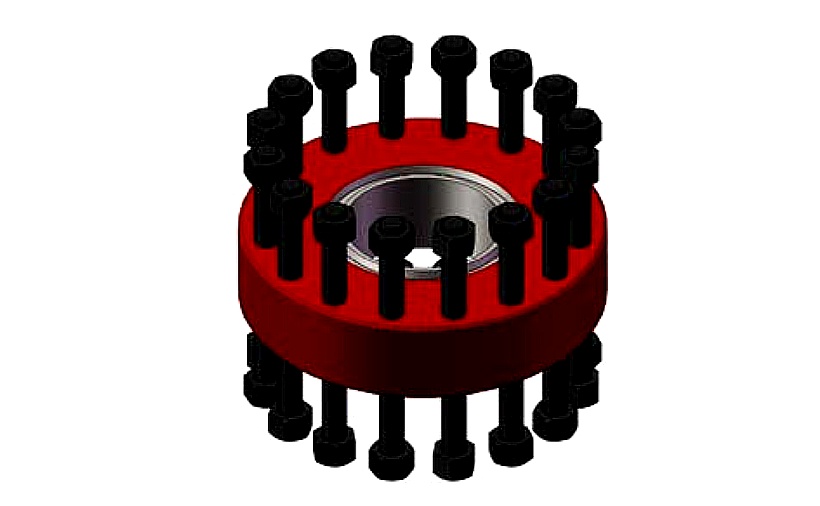
DEENPU API 6A Double Studded Adapter (DSA) — Through Bore with Ring Grooves on Both Sides
DEENPU Double Studded Adapter (DSA) is a critical wellhead and manifold component manufactured in strict accordance with API 6A specification. It is a solid forged or bar stock flange with a through bore, featuring a ring groove on each side, drilled and tapped bolt hole sets on both ends, and fitted with double studded bolts and nuts complete on both sides. Unlike a spacer spool or standard companion flange, the two sides of a DSA are typically different in nominal size and/or pressure rating, making it an essential adapter for connecting dissimilar API 6A flanges in wellhead assemblies, choke manifolds, kill lines, and production systems.
All DEENPU DSA products are manufactured to meet or exceed API 6A, NACE MR0175, ISO 9001, ISO 14001, and ANSI standards. They are suitable for both General Service and Sour Service (H2S) conditions, with material grades and heat treatments selected to resist sulfide stress cracking in hydrogen sulfide environments. Each DSA is supplied with full traceability documentation for every component, including material certificates, heat treatment records, hydrostatic test reports, and dimensional inspection certificates.
DEENPU DSA adapters are available in a wide range of bore sizes from 2-1/16″ to 30″ and pressure ratings from 2M (2,000 PSI) to 15M (15,000 PSI), covering all standard API 6A flange combinations. Custom configurations with non-standard bore sizes, pressure ratings, and connection types are available on request. In addition to DSAs, DEENPU also manufactures and supplies a complete range of API 6A flanges including threaded flanges, spacer spools, blind flanges, companion flanges, target flanges, test flanges, and adapter spools to meet all client requirements.
How the Double Studded Adapter Works
The Double Studded Adapter performs three essential functions in wellhead and manifold systems:
- Flange Size and Rating Transition — The primary function of a DSA is to connect two API 6A flanges that have different nominal bore sizes, different pressure ratings, or both. For example, a DSA can connect a 2-1/16″ 5M (5,000 PSI) flange on one side to a 4-1/16″ 10M (10,000 PSI) flange on the other side. The DSA has a ring groove machined on each end face to match the ring gasket type (BX, RX, or R) of the corresponding flange. The bolt holes are drilled and tapped to accept the stud bolts and nuts of each flange. The through bore is machined to the larger of the two connected bore sizes to ensure unrestricted flow and prevent pressure restrictions. The overall thickness of the DSA is engineered to provide sufficient strength to withstand the higher of the two pressure ratings.
- Pressure-Sealed Connection — The DSA creates a metal-to-metal seal between the two flanges using the standard API 6A ring gasket system. The ring groove on each side is precision-machined to match the ring gasket type (BX, RX, or R) with the correct groove angle and surface finish. When the flange bolts are torqued to specification, the ring gasket is compressed between the groove faces, creating a leak-tight, pressure-rated seal. The DSA itself is forged from a solid billet or bar stock, eliminating the risk of weld failure or joint leakage. The material is selected and heat-treated to achieve the mechanical properties required for the pressure rating and service conditions (General or Sour Service).
- Structural Integrity and System Integration — The DSA acts as a rigid, integral structural member in the wellhead or manifold assembly. Its thickness is calculated to withstand the bending moments and axial loads from the connected piping, valves, and equipment. The bolt hole pattern and stud arrangement are designed to match the API 6A flange standard for each side, ensuring that the bolt loads are distributed evenly and the flange faces remain parallel under pressure. The DSA can be installed in any orientation (vertical, horizontal, or angled) and serves as a permanent or temporary connection point between wellhead components, manifold branches, or pipeline sections.
Key Features
Applications
- Wellhead assemblies — Connecting casing heads, tubing heads, and Christmas tree components with different bore sizes and pressure ratings
- Choke and kill manifolds — Adapting between high-pressure kill lines and lower-pressure production lines in well control systems
- Production manifolds — Connecting multiple wellheads to a central production header with different flange specifications
- Test and workover systems — Temporary and permanent connections for BOP stacks, test manifolds, and workover equipment
- Pipeline tie-ins — Adapting between wellhead flanges and pipeline flanges with different API and ANSI ratings
- Shipbuilding and offshore platforms — Marine and offshore piping systems requiring API 6A rated connections
- Injection systems — Water, gas, and chemical injection manifolds requiring high-pressure sour service connections
- API 6A equipment modification — Retrofitting and upgrading existing wellheads with different flange configurations
Standard DSA Specifications
| DSA Configuration | Flange Size × Pressure Rating (Top) | Flange Size × Pressure Rating (Bottom) | Flange Thickness (mm) |
|---|---|---|---|
| DSA-1 | 2-1/16″ × 5M | 3-1/8″ × 5M | 70 |
| DSA-2 | 2-1/16″ × 10M | 4-1/16″ × 10M | 80 |
| DSA-3 | 3-1/16″ × 10M | 4-1/16″ × 10M | 130 |
| DSA-4 | 3-1/16″ × 10M | 4-1/16″ × 5M | 80 |
| DSA-5 | 4-1/16″ × 5M | 2-1/16″ × 5M | 75 |
| DSA-6 | 4-1/16″ × 5M | 3-1/8″ × 5M | 83 |
| DSA-7 | 4-1/16″ × 2M | 4-1/16″ × 5M | 80 |
| DSA-8 | 7-1/16″ × 10M | 13-5/8″ × 10M | 170 |
| DSA-9 | 7-1/16″ × 5M | 13-5/8″ × 5M | 150 |
| DSA-10 | 11″ × 15M | 18-3/4″ × 15M | 256 |
| DSA-11 | 11″ × 5M | 13-5/8″ × 5M | 144 |
| DSA-12 | 13-5/8″ × 10M | 11″ × 10M | 267 |
| DSA-13 | 13-5/8″ × 3M | 16-3/4″ × 2M | 150 |
| DSA-14 | 13-5/8″ × 10M | 18-3/4″ × 15M | 256 |
| DSA-15 | 13-5/8″ × 5M | 18-3/4″ × 15M | 256 |
| DSA-16 | 18-3/4″ × 15M | 20-3/4″ × 3M | 270 |
| DSA-17 | 20-3/4″ × 3M | 18-3/4″ × 15M | 256 |
| DSA-18 | 21-3/4″ × 2M | 18-3/4″ × 15M | 256 |
| DSA-19 | 21-3/4″ × 2M | 18-3/4″ × 15M | 200 |
| DSA-20 | 26-3/4″ × 3M | 21-3/4″ × 2M | 200 |
| DSA-21 | 30″ × 3M | 21-3/4″ × 2M | 175 |
| DSA-22 | 30″ × 1M | 26-3/4″ × 3M | 200 |
All dimensions per API 6A 21st Edition. Standard ring gasket types: BX for 6BX flanges, RX for 6B flanges, R for type 6B flanges. Pressure ratings: 2M = 2,000 PSI, 3M = 3,000 PSI, 5M = 5,000 PSI, 10M = 10,000 PSI, 15M = 15,000 PSI. Other sizes and pressure ratings are available upon request. Contact us for custom configurations, non-standard bore combinations, and special material grades.
When Ordering, Please Specify
- Top Side Flange SpecificationNominal bore size (e.g., 2-1/16″, 4-1/16″, 7-1/16″, 13-5/8″, 18-3/4″, 30″). Pressure rating (2M, 3M, 5M, 10M, 15M). Ring gasket type (BX, RX, or R).
- Bottom Side Flange SpecificationNominal bore size. Pressure rating. Ring gasket type. Specify if the same or different from the top side.
- Service ConditionsGeneral Service (sweet) or Sour Service (H2S). Specify H2S partial pressure, CO2 content, and temperature for sour service material selection.
- Material GradeAPI 6A material grade: AA, BB, CC, DD, EE, FF, or HH. For sour service, specify NACE MR0175 compliant grade. For low-temperature service, specify impact test requirements.
- Material SpecificationCarbon steel (AISI 4130/4140), low-alloy steel, or stainless steel ( duplex, super duplex). Specify for corrosive, high-temperature, or sour service environments.
- Flange Thickness / Overall LengthStandard thickness per API 6A or custom length for specific spacing requirements. Specify if the DSA must match existing spool or adapter dimensions.
- Through Bore RequirementStandard bore (larger of the two flange sizes) or restricted bore for flow control. Specify if a bore restriction or bore liner is required.
- Stud Bolts and NutsASTM A193 B7 / B7M studs with A194 2H / 2HM nuts (standard). Specify if alternative materials (B8, B8M, L7) are required for temperature or corrosion resistance.
- Coating and Surface FinishStandard machined finish or protective coating (epoxy, PTFE, zinc phosphate). Specify for corrosion protection or identification.
- Certification RequirementsAPI 6A material certification, NACE MR0175 compliance certificate, hydrostatic test certificate, dimensional inspection report, NDT reports (UT/MPI), and third-party inspection (DNV, BV, SGS, ABS).
Custom Manufacturing & OEM Capability
- Non-Standard Bore Combinations — Any combination of API 6A bore sizes and pressure ratings not listed in the standard table. Custom engineered for specific wellhead and manifold configurations.
- Special Material Grades — Duplex stainless steel (2205, 2507), super duplex, Inconel, Monel, and other corrosion-resistant alloys for extreme sour service and high-temperature applications.
- Multi-Bore DSA — Double-bore or triple-bore configurations for dual-completion and triple-completion wellheads. Multiple through bores in a single flange body.
- Integral Valve & Instrument Ports — Machined ports for pressure gauges, temperature sensors, injection lines, and bleed valves integrated into the DSA body.
- Cladded / Overlay DSA — Inconel 625 or 316L stainless steel weld overlay on wetted surfaces for corrosion resistance without full alloy construction cost.
- Special Ring Gasket Configurations — BX, RX, R, or special groove profiles. Dual-groove configurations for redundant sealing systems.
- Alignment and Locating Features — Alignment pins, dowel holes, and locating shoulders for precise assembly and repeatable positioning in subsea and critical applications.
- Complete Wellhead Package — DSA supplied as part of a complete wellhead assembly including casing heads, tubing heads, Christmas trees, valves, and manifolds.
Quality Control & Testing Standards
- Material chemical composition verified per heat. Carbon, manganese, chromium, nickel, molybdenum, and sulfur content verified against API 6A material grade requirements.
- Material mechanical properties tested per heat including tensile strength, yield strength, elongation, and hardness per API 6A.
- Impact testing at specified temperature for low-temperature service per API 6A and ASTM A370.
- Each DSA hydrostatically tested to 1.5x rated working pressure per API 6A. Hold time, pressure, and leak rate recorded on test certificate.
- Dimensional inspection full OD, ID, thickness, ring groove dimensions, bolt circle diameter, and bolt hole pattern verified against API 6A tolerances.
- Ring groove surface finish and groove angle inspected with precision gauges and optical comparators to ensure gasket compatibility and sealing performance.
- Stud bolt holes thread inspected with go/no-go gauges and bolt hole pattern verified with coordinate measuring machine (CMM) or jig.
- NDT inspection: ultrasonic testing (UT) and magnetic particle inspection (MPI) on 100% of the forging body per API 6A.
- Material test certificates (MTC) per EN 10204 3.1 provided for all forged and bar stock materials.
- Third-party inspection and certification by DNV, BV, SGS, or ABS available upon request.
Frequently Asked Questions
What is the difference between a DSA, a spacer spool, and a companion flange?
A Double Studded Adapter (DSA) has a through bore and is drilled and tapped on both ends with different sizes and/or pressure ratings. It is used to connect two dissimilar flanges. A spacer spool has a through bore and is drilled and tapped on both ends with the same size and pressure rating. It is used to add space between two identical flanges. A companion flange is a single-ended flange with a ring groove and bolt holes on one side and a hub or threaded connection on the other side. It is used to terminate a flange connection or adapt to a pipe thread. The key distinction is that the DSA has two different flange specifications on the two ends, while a spacer spool has two identical flange specifications.
What ring gasket type do I need for my DSA?
The ring gasket type depends on the API 6A flange type on each side of the DSA: BX gaskets are used with 6BX flanges (API 6A Type 6BX), which are typically used for high-pressure ratings (5M, 10M, 15M) and are designed for face-to-face contact with the ring gasket seated in the groove. RX gaskets are used with 6B flanges (API 6A Type 6B) and are pressure-energized, meaning the internal pressure increases the sealing force on the gasket. R gaskets are also used with 6B flanges but are not pressure-energized. The DSA must have the correct ring groove machined for the gasket type (BX, RX, or R) on each side. The gasket type is determined by the flange specification you are connecting to, not by the DSA itself. Always specify the ring gasket type for both the top and bottom flanges when ordering a DSA.
What is the difference between General Service and Sour Service for a DSA?
General Service refers to wellhead and manifold applications where the fluid contains minimal or no hydrogen sulfide (H2S). Standard carbon steel or low-alloy steel material grades (AA, BB, CC, DD) are suitable for General Service. Sour Service refers to applications where the fluid contains H2S at concentrations and partial pressures that can cause sulfide stress cracking (SSC) in susceptible materials. For Sour Service, the material must meet NACE MR0175 / ISO 15156 requirements for resistance to SSC. This typically requires: lower hardness (maximum 22 HRC or 237 HBW), controlled chemical composition (low sulfur, controlled nickel content), and specific heat treatment parameters (quench and temper with minimum tempering temperature). DEENPU provides Sour Service DSAs in material grades EE, FF, and HH with full NACE MR0175 compliance certificates. Always specify Sour Service when the H2S partial pressure exceeds 0.05 psi (0.3 kPa) or when the service environment is known to contain H2S.
How do I determine the correct flange thickness for my DSA?
DSA flange thickness is determined by three factors: (1) The higher of the two pressure ratings on the connected flanges. The DSA must be thick enough to withstand the higher pressure rating without excessive deflection or stress. (2) The larger of the two bore sizes. Larger bores require greater thickness to maintain structural integrity under pressure. (3) API 6A minimum thickness requirements. API 6A specifies minimum flange thicknesses for each bore size and pressure rating combination. DEENPU standard DSA thicknesses are listed in the specification table above and meet or exceed API 6A requirements. Custom thicknesses can be manufactured for specific spacing requirements, but the thickness must always be sufficient for the pressure rating. If you are replacing an existing DSA, measure the existing thickness and bolt length to ensure compatibility. Contact our engineering team for custom thickness calculations.
Can a DSA be used as a permanent or temporary connection?
Yes, DSAs are designed for both permanent and temporary installations. As a permanent connection, the DSA is bolted into the wellhead or manifold assembly with the correct torque specification and remains in place for the life of the well. The solid forged construction and API 6A certification make it suitable for long-term, high-pressure service. As a temporary connection, DSAs are commonly used in test and workover operations where dissimilar equipment must be connected for a limited period. For temporary installations, the DSA is assembled with standard API ring gaskets and stud bolts, and can be disassembled and reused when the operation is complete. The ring gasket should be replaced after each disassembly, but the DSA body itself can be reused indefinitely if inspected and re-certified. Temporary DSAs are often used in BOP test stacks, well test manifolds, and workover rig connections.
What certifications do your DSAs carry?
DEENPU Double Studded Adapters are manufactured in accordance with API 6A (Specification for Wellhead and Christmas Tree Equipment) and are suitable for both General Service and Sour Service per NACE MR0175 / ISO 15156. Our manufacturing facility operates under ISO 9001 (Quality Management System) and ISO 14001 (Environmental Management System) certification. Each DSA is supplied with a complete documentation package including: material test certificate (chemical composition and mechanical properties), heat treatment certificate, hydrostatic test certificate, dimensional inspection report, NDT reports (UT and MPI), and ring groove inspection report. For Sour Service applications, a NACE MR0175 compliance certificate is provided. Material traceability is maintained from the raw material mill certificate through forging, heat treatment, machining, testing, and final inspection. Third-party inspection and certification by DNV, BV, SGS, or ABS is available on request for projects requiring classification society approval or customer-specific quality assurance protocols.
Request a Quote — Double Studded Adapter
Send your wellhead or manifold flange specifications and we will recommend the optimal DSA configuration with a complete proposal including pricing, delivery schedule, and test certificates within 48 hours.
- EMAILSALES@DEENPU-MACHINERY.COM
- WHATSAPP+86-15806284962
- RESPONSEQuotation within 48 hours
Include: Top flange size and pressure rating, bottom flange size and pressure rating, service condition (general or sour), material grade, and quantity.
About Us
 Our company has been in the oil & gas drilling equipment industry for over more years, We are here to serve all your drilling equipment needs.