
Heavy Weight Drill Pipe (HWDP) — 4145H Alloy Steel, API 7-1 Compliant
SY/T 5146-1997 Standard • 3-1/2"–5-1/2" Size • Central Upset Protection • Hardbanding & Internal Coating Available
Product Overview
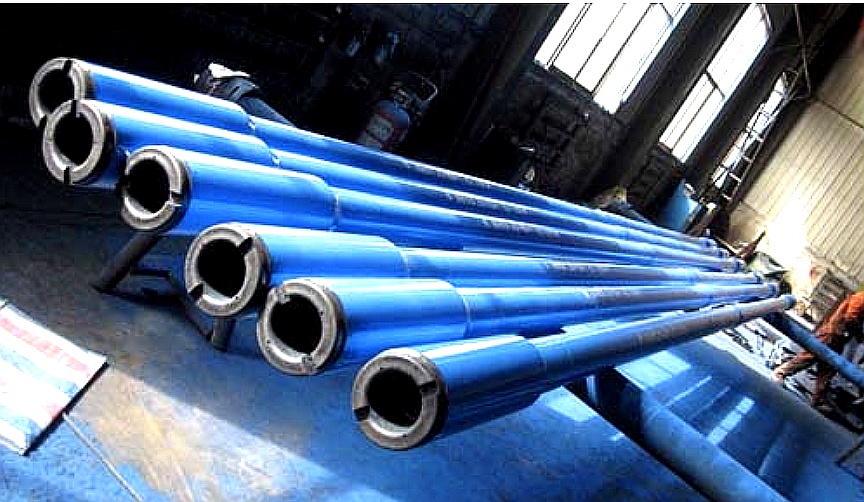
DEENPU Heavy Weight Drill Pipe (HWDP) in 4145H Alloy Steel with Central Upset Protection
DEENPU Heavy Weight Drill Pipe (HWDP) is a specialized drill string component designed to provide additional weight and stiffness in the drill string while maintaining the flexibility needed for directional and horizontal drilling operations. Manufactured from high-quality 4145H alloy structural steel in accordance with SY/T 5146-1997 standard, with tool joint threads manufactured to API 7-1 specification, DEENPU HWDP delivers the strength, durability, and performance required for the most demanding drilling environments.
Unlike conventional drill pipe, HWDP features a thicker wall section and a central upset diameter that is larger than the tube body. This enlarged mid-section serves as a wear pad, protecting the pipe from excessive wear when contacting the wellbore wall during rotation. The tool joints are precision-machined with API 7-1 standard threads and are available in a range of sizes and connections to match existing drill string components. Optional hardbanding and internal coating can be applied to further extend service life and protect against corrosion and erosion.
DEENPU HWDP is available in sizes from 3-1/2″ to 5-1/2″, with tool joint connections including NC38, NC40, NC46, NC50, and 5-1/2″ FH. Each pipe is heat-treated to achieve the optimal balance of strength, toughness, and fatigue resistance. The central upset design provides a bearing surface that reduces contact stress on the tube body, significantly extending the operational life of the pipe in abrasive formations.
How Heavy Weight Drill Pipe Works
Heavy Weight Drill Pipe serves as the critical transition component in the drill string, performing three essential functions:
- Transition Between Drill Collars and Drill Pipe — In a typical drill string, the heavy drill collars provide weight on bit (WOB) but their stiffness creates a sharp transition to the more flexible drill pipe above. This stiffness mismatch can cause stress concentrations, fatigue failures, and connection damage at the collar-to-pipe interface. HWDP is inserted between the drill collars and the drill pipe as a flexible weight member, providing a gradual stiffness transition that reduces stress concentrations and improves the fatigue life of the entire drill string. The HWDP’s intermediate weight and stiffness bridge the gap between the rigid collars and the flexible pipe, distributing loads more evenly and preventing premature connection failures.
- Weight Member for Directional and Horizontal Drilling — In directional and horizontal drilling, the drill string must navigate curved wellbore sections where the weight of the collars alone may not be sufficient to maintain the required weight on bit. HWDP provides additional weight in the curved section while maintaining the flexibility needed to pass through the bend without excessive stress. The pipe’s larger wall thickness and central upset provide the mass needed for WOB, while the tube body remains flexible enough to accommodate the wellbore curvature. In horizontal wells, HWDP is often placed in the high-side curve below the drill collars to provide weight and stiffness in the lateral section where collars cannot be run.
- Weight and Protection in Small Rig Operations — On smaller drilling rigs with limited derrick capacity and hoisting capability, drill collars may be too heavy or too large to handle safely. HWDP provides a lighter alternative that still delivers sufficient weight on bit for drilling small-diameter holes. Additionally, the central upset diameter acts as a protective wear pad that contacts the wellbore wall instead of the thinner tube body, reducing wear and extending the life of the pipe in abrasive formations. The upset also provides a bearing surface that reduces buckling tendency when the pipe is in compression, improving directional stability.
Key Features
Applications
- Drill collar to drill pipe transition — Run between heavy drill collars and standard drill pipe to provide a gradual stiffness transition and reduce stress concentrations
- Directional and horizontal drilling — Flexible weight member in curved and lateral wellbore sections. Provides WOB without the stiffness issues of drill collars
- Small rig drilling operations — Weight member for small drilling rigs and workover units where drill collars are too heavy or too large
- High-angle and extended-reach drilling — Provides weight and stiffness in the high-angle build section where drill collars cannot be run
- Horizontal well lateral sections — Run in the lateral section below the drill collars to provide weight on bit and reduce torque and drag
- Deep drilling operations — Additional weight member for deep wells where the drill string is in compression and buckling must be minimized
- Abrasive formation drilling — Central upset wear pad reduces tube body wear in abrasive formations, extending pipe life
- Well workover and intervention — Intermediate weight member for workover rigs performing drilling, milling, and fishing operations
Technical Specifications
| Size (in) |
O.D. (in) |
I.D. (in) |
Tool Joint O.D. (in) |
Tool Joint I.D. (in) |
Thread | Max Elevator Dia. (in) |
Central Upset Dia. (in) |
Min Drift Dia. (in) |
|---|---|---|---|---|---|---|---|---|
| 3-1/2 | 3-1/2 | 2-1/4 | 4-3/4 (4-7/8, 5) |
2-1/4 | NC38 | 3-7/8 | 4 | 2-1/16 |
| 4 | 4 | 2-1/2 | 5-1/4 | 2-1/2 | NC40 | 4-3/16 | 4-1/2 | 2-9/16 |
| 4-1/2 | 4-1/2 | 2-11/16 | 6-1/4 | 2-11/16 | NC46 | 4-11/16 | 5 | 2-7/16 |
| 5 | 5 | 3-1/4 | 7 (7-1/4, 7-1/2) |
3-1/4 | NC50 | 5-1/8 | 5-1/2 | 3-1/8 |
| 5-1/2 | 5-1/2 | 3-3/4 | 8 (8-1/4, 8-1/2) |
3-3/4 | 5-1/2 FH | 6-15/16 | 7-1/8 | 3-3/4 |
Tool joint O.D. shown as standard, with optional larger sizes in parentheses. Central upset diameter is the enlarged mid-section outer diameter that provides wear protection. Drift diameter is the minimum guaranteed internal diameter after manufacturing. Contact us for additional sizes, custom tool joint connections, and hardbanding specifications.
When Ordering, Please Specify
- Pipe SizeStandard sizes: 3-1/2″, 4″, 4-1/2″, 5″, or 5-1/2″. Custom sizes available on request.
- Tool Joint ConnectionThread type and size: NC38, NC40, NC46, NC50, 5-1/2″ FH, or other API or proprietary connection. Specify pin and box requirements.
- Tool Joint O.D. and I.D.Standard or oversized tool joint O.D. for enhanced torque capacity. Specify internal diameter for flow rate requirements.
- Hardbanding RequirementsArnco 100XT, Arnco 300XT, tungsten carbide, or other hardbanding material. Specify application on box, pin, or both.
- Internal CoatingEpoxy, phenolic, or other corrosion-resistant internal coating. Specify if required for H2S, CO2, or corrosive drilling fluid environments.
- Material Grade4145H standard or alternative alloy steel grade per customer specification. Specify heat treatment requirements.
- Length and QuantityStandard length range: 30-32 feet (9.1-9.8 meters) per pipe. Specify total quantity and any custom length requirements.
- Certification RequirementsMaterial test certificates (MTC), heat treatment certificates, dimensional inspection reports, drift test certificates, and third-party inspection (DNV, BV, SGS).
- Delivery and PackagingDelivery schedule, shipping destination, and packaging requirements. Thread protectors and export packaging included as standard.
Custom Manufacturing & OEM Capability
- Non-Standard Sizes — Custom outer diameters, wall thicknesses, and internal diameters manufactured to customer specifications for specialized drilling applications.
- Special Tool Joint Connections — Proprietary threaded connections, double-shoulder connections, or premium connections manufactured to customer drawing.
- Hardbanding Options — Standard Arnco 100XT/300XT, tungsten carbide matrix, or custom hardbanding materials. Applied to full-length tube or selective areas.
- Internal Coating — Epoxy, phenolic, ceramic, or specialized corrosion-resistant coatings for sour gas, CO2, and high-temperature drilling environments.
- Material Upgrades — Alternative alloy steels (4140H, 4340, 15CrMo, etc.) with enhanced mechanical properties for extreme downhole conditions.
- Upset Design Variations — Custom central upset profiles, lengths, and diameters optimized for specific wellbore geometry and wear patterns.
- Branding & Traceability — Customer-specific markings, color coding, stenciling, and full traceability documentation per pipe.
Quality Control & Testing Standards
- Material chemical composition and mechanical properties tested per batch. 4145H alloy steel verified for tensile strength, yield strength, elongation, and impact toughness.
- Tool joint threads inspected with API ring and plug gauges per API 7-1 specification. Standoff, thread length, and pitch diameter verified.
- Full-length pipe dimensional inspection including O.D., I.D., wall thickness, straightness, and length per SY/T 5146-1997.
- Drift test performed with API standard drift mandrel to verify minimum internal diameter throughout the pipe length.
- Heat treatment hardness and microstructure verified on each production lot. Quench and temper parameters monitored and recorded.
- Surface inspection for cracks, seams, and defects using magnetic particle inspection (MPI) and ultrasonic testing (UT).
- Hardbanding (if applicable) visual and dimensional inspection verified for coverage, thickness, and bond integrity.
- Internal coating (if applicable) holiday detection and thickness verification per NACE SP0288.
- Material test certificates (MTC) per EN 10204 3.1 provided for all pipe and tool joint materials.
- Third-party inspection and certification by DNV, BV, SGS, or ABS available upon request.
Frequently Asked Questions
What is the difference between heavy weight drill pipe and standard drill pipe?
Standard drill pipe is designed primarily for fluid conveyance and torque transmission in the drill string, with relatively thin walls (typically 0.25-0.5 inches) and standard tool joints. Heavy weight drill pipe (HWDP) has thicker walls (typically 0.5-1.0 inches), a larger central upset diameter, and heavier tool joints. HWDP is designed to provide weight and stiffness in the drill string while maintaining flexibility. The central upset acts as a wear pad, and the heavier construction provides approximately 2-3 times the weight per foot of standard drill pipe. HWDP is used as a transition member between drill collars and drill pipe, or as a weight member in directional drilling where drill collars are too stiff.
What is the difference between heavy weight drill pipe and drill collars?
Drill collars are thick-walled, heavy steel bars (typically 4-10 inches O.D. with 1-3 inch bores) designed to provide maximum weight on bit and maximum stiffness. They are rigid and do not flex well in curved wellbores. Heavy weight drill pipe has a thinner wall than drill collars but thicker than standard drill pipe, with a tube body that is more flexible than a collar. HWDP provides intermediate weight and stiffness, making it ideal for the transition zone between collars and pipe, and for curved wellbore sections where collar stiffness would cause problems. HWDP is approximately 50-70% of the weight of a drill collar of the same O.D. but is significantly more flexible and easier to handle.
Where should heavy weight drill pipe be placed in the drill string?
HWDP is typically placed in one of three locations: (1) Between drill collars and drill pipe as a transition member to reduce stress concentrations and fatigue failures at the collar-to-pipe interface. This is the most common application. (2) In the curved section of directional and horizontal wells below the drill collars to provide weight and stiffness in the high-angle build section where collars cannot be run due to stiffness constraints. (3) In the horizontal lateral section to provide weight on bit without the excessive stiffness of drill collars that would increase torque and drag. The number of HWDP stands required depends on the well profile, weight on bit requirements, and rig capacity. Our engineering team can calculate the optimal HWDP placement based on your well plan.
What is hardbanding and do I need it?
Hardbanding is a wear-resistant alloy applied to the tool joint surfaces (box and pin) to protect against abrasive wear when the joint contacts the wellbore wall during rotation. Without hardbanding, tool joints can wear rapidly in abrasive formations, reducing the connection life and requiring premature replacement. Hardbanding can extend tool joint life by 300-500% in abrasive environments. Common hardbanding materials include Arnco 100XT (iron-based, non-magnetic, good for general service), Arnco 300XT (higher hardness for severe abrasion), and tungsten carbide (highest hardness for extreme abrasion). We recommend hardbanding for all drilling operations in sandstone, conglomerate, and other abrasive formations. It is optional but highly recommended for cost-effective drilling.
What is internal coating and when is it required?
Internal coating is a corrosion-resistant lining applied to the inner surface of the pipe to protect against internal corrosion and erosion from drilling fluids. Common coatings include epoxy (general corrosion protection), phenolic (high-temperature and chemical resistance), and ceramic (extreme erosion resistance). Internal coating is recommended when: (1) drilling in sour gas environments (H2S-bearing formations) where sulfide stress cracking is a risk; (2) using corrosive drilling fluids (high chloride, acidic, or oxygenated mud systems); (3) drilling in CO2-bearing formations where carbonic acid corrosion is a concern; (4) extended drilling campaigns where internal corrosion over time would reduce pipe life; (5) operations where reduced pressure drop from a smooth coated surface is beneficial for hydraulics. DEENPU applies internal coating using automated spray and bake processes that ensure uniform coverage and adhesion.
What certifications do your heavy weight drill pipes carry?
DEENPU heavy weight drill pipes are manufactured in accordance with SY/T 5146-1997 (Chinese petroleum industry standard for heavy weight drill pipe) and API 7-1 (Specification for Rotary Drill Stem Elements) for tool joint threads. Each pipe is supplied with full documentation including material test certificates (chemical composition and mechanical properties), heat treatment certificates, dimensional inspection reports, drift test certificates, and thread inspection reports. Material traceability is maintained from raw material to finished product. Third-party inspection and certification by DNV, BV, SGS, or ABS is available on request for projects requiring classification society approval or customer-specific quality assurance requirements.
Request a Quote — Heavy Weight Drill Pipe
Send your drill string specifications and we will recommend the optimal HWDP size, connection, and configuration with a complete proposal including pricing, delivery schedule, and test certificates within 48 hours.
- EMAILSALES@DEENPU-MACHINERY.COM
- WHATSAPP+86-15806284962
- RESPONSEQuotation within 48 hours
Include: Pipe size, tool joint connection, hardbanding requirement, internal coating requirement, quantity, and drilling environment (vertical, directional, or horizontal).
About Us
 Our company has been in the oil & gas drilling equipment industry for over more years, We are here to serve all your drilling equipment needs.