
BOP Testing Unit | Pressure Test Pump for BOP Stack & Wellhead
Pneumatic / Electric / Electro-Pneumatic • 5,000–20,000 PSI • API 16D Certified • Chart Recorder & Hose Assembly Available
ISO 9001:2015
5,000–20,000 PSI
Pneumatic & Electric
Chart Recorder
Product Overview
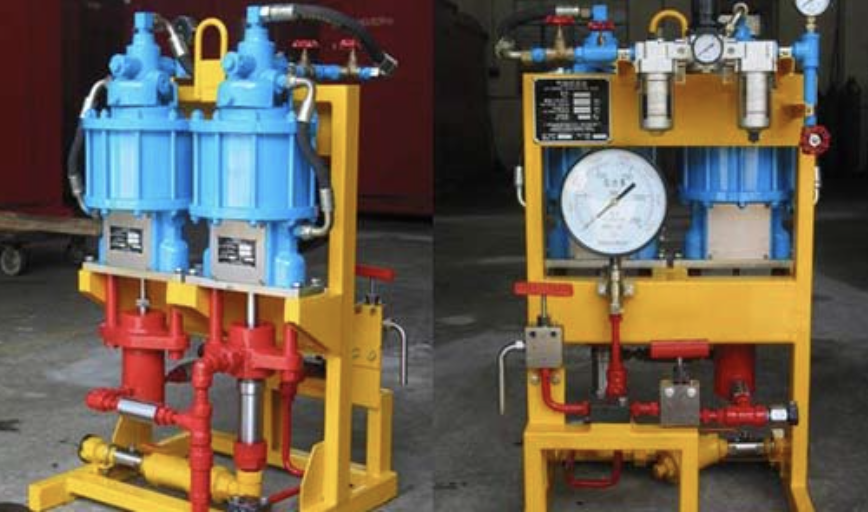
DEENPU BOP Testing Unit (Pressure Test Pump) — Pneumatic & Electric Dual-Pump Configuration
The BOP Testing Unit, also known as a pressure test pump, is designed for high-pressure static testing of BOP stacks, choke and kill lines, Christmas trees, and any other equipment requiring controlled pressure verification. It is an essential tool in drilling, workover, and well servicing operations to ensure well control equipment integrity before and after use.
Deenpu Machinery manufactures pneumatic, electric, and electro-pneumatic BOP testing units in accordance with API 16D. Available in portable, unit-mounted, skid-mounted, and vehicle-mounted configurations, with working pressure ranges from 5,000 PSI to 20,000 PSI. Accessories include stand-mounted chart recorders and high-pressure hose assemblies. All units are function-tested at our Yancheng facility before shipment.
How the BOP Testing Unit Works
The BOP testing unit generates controlled high-pressure fluid to perform hydrostatic testing on well control equipment. The working principle depends on the pump type:
- Pneumatic Pump (Air-Driven) — Uses compressed air (0.7 MPa / 100 psi) to drive a reciprocating pump. Air pressure is amplified through a pressure ratio (1:30, 1:60, 1:100, 1:200, or 1:225) to achieve output pressures up to 140 MPa. The pump stops automatically when output pressure balances air drive pressure.
- Electric Pump (Motor-Driven) — An explosion-proof electric motor drives a triplex or high-pressure plunger pump. Provides continuous flow for large-volume testing (e.g., full BOP stack). Working pressure: 35 MPa or 105 MPa.
- Electro-Pneumatic Hybrid — Combines an electric triplex pump for high-flow pre-fill with a pneumatic booster pump for final high-pressure static testing. The electric pump rapidly fills the test object, then the pneumatic pump takes over to reach and hold the target test pressure with minimal energy consumption.
All configurations include a pressure chart recorder that automatically plots pressure vs. time, providing a documented test record for regulatory compliance and client reporting. The recorder can print, store, and track test data for quality assurance.
Key Features
Applications
- BOP Stack Hydrostatic Testing — Annular preventers, ram BOPs, and shear rams on surface and subsea stacks
- Choke & Kill Line Testing — High-pressure manifold lines and valves
- Christmas Tree & Wellhead Testing — Casing heads, tubing heads, and production tree assemblies
- Hydraulic Gate Valve & HCR Testing — API 6A valve seat and body integrity verification
- Accumulator Unit Testing — BOP closing unit pressure verification and pre-charge validation
- Drill Pipe & Tubing Pressure Testing — Thread and body integrity checks
- Pressure Vessel & Pipeline Testing — Static pressure hold tests for any high-pressure equipment
Technical Specifications
Pneumatic High Pressure Test Unit
| Model | Pneumatic Pump Ratio | Rated Air Input | Working Pressure | Oil Tank | Max Pressure | Recorder |
|---|---|---|---|---|---|---|
| QT21 | 1:30 | 0.7 MPa | 21 MPa | 45 L | 21 MPa | 0 set |
| QT21-J | 1:30 | 0.7 MPa | 21 MPa | 45 L | 21 MPa | 1 set |
| QT35 | 1:100 / 1:60 | 0.5–0.8 MPa | 35 MPa | 100 L | 35 MPa | 0 set |
| QT35-J | 1:100 / 1:60 | 0.5–0.8 MPa | 35 MPa | 100 L | 35 MPa | 1 set |
| QT70 | 1:60 | 0.7 MPa | 70 MPa | 100 L | 70 MPa | 0 set |
| QT70-J | 1:60 | 0.7 MPa | 70 MPa | 100 L | 70 MPa | 1 set |
| QT140 | 1:60 | 0.7 MPa | 105 MPa | 100 L | 140 MPa | 0 set |
| QT140-J | 1:60 | 0.7 MPa | 105 MPa | 100 L | 140 MPa | 1 set |
| QT200 | 1:60 | 0.9 MPa | 105 MPa | 100 L | 200 MPa | 0 set |
| QT200-J | 1:60 | 0.9 MPa | 105 MPa | 100 L | 200 MPa | 1 set |
Electric Pressure Test Unit
| Item | DT35-J | DT105-J |
|---|---|---|
| Working Pressure | 35 MPa | 105 MPa |
| Supply Power | 380 VAC, 3 Phase, 50 Hz | 380 VAC, 3 Phase, 50 Hz |
| Motor Power | 30 kW | 55 kW |
| Pump Displacement | 2,300 L/h | 1,560 L/h |
| Ambient Temperature | −10 to +50°C | −10 to +50°C |
| High Pressure Hose | 70 MPa, ID 12.7 mm, NPT 1″ Female | 105 MPa, ID 12.7 mm, M24×1.5 Female |
Electro-Pneumatic High Pressure Test Unit
| Item | DQT70-J | DQT105-J |
|---|---|---|
| Working Pressure | 70 MPa | 105 MPa |
| Supply Power | 380 VAC, 3 Phase, 50 Hz | 380 VAC, 3 Phase, 50 Hz |
| Air Source Pressure | 0.7 MPa (100 psi) | 0.7 MPa (100 psi) |
| Air Consumption | 1.5 m³/min | 1.5 m³/min |
| Ambient Temperature | −10 to +50°C | −10 to +50°C |
| Triplex Pump Displacement | 50 L/min | 21 L/min |
| Pneumatic Pump Displacement | 1:30 (180 mL/stroke), 1:100 (30 mL/stroke) | 1:60 (90 mL/stroke), 1:200 (14 mL/stroke) |
| Bursting Pressure | 86 MPa | 168 MPa |
When Ordering, Please Specify
To provide an accurate quotation and datasheet, please include the following with your inquiry:
- Test Object TypeBOP stack, Christmas tree, choke & kill manifold, or other equipment. Specify maximum test pressure required.
- Pump TypePneumatic (QT series), electric (DT series), or electro-pneumatic (DQT series).
- Working PressureMaximum test pressure in MPa or PSI (e.g., 70 MPa, 105 MPa, 140 MPa, 200 MPa).
- Chart RecorderWith or without stand-mounted chart recorder (J suffix models include recorder).
- Mounting ConfigurationPortable cart, skid-mounted, or vehicle-mounted for field operations.
- High Pressure HoseRequired length, working pressure rating, and end connection type (NPT, API, or custom).
- Power SupplyVoltage, frequency, and phase (e.g., 380V/50Hz/3-phase, 480V/60Hz/3-phase).
- Explosion-Proof RequirementEx d IIB T4 or Ex d IIC T6 for hazardous area deployment.
- AccessoriesAdditional chart recorder paper, high-pressure hose assemblies, test fittings, or calibration certificate.
- Delivery LocationPort of discharge for shipping quotation and delivery time estimate.
Custom Manufacturing & OEM Capability
- Pressure Range Customization — Standard 21–200 MPa; higher pressure ratings available on request.
- Dual-Pump Configuration — Combine two pneumatic pumps with different ratios for flexible pressure steps.
- Multiple Test Ports — Manifold with multiple quick-connect outlets for simultaneous multi-object testing.
- Digital Pressure Recorder — Upgrade from analog chart recorder to digital data logger with USB export and Bluetooth.
- Brand & Documentation — OEM nameplates, paint colors, and multilingual manuals (English, Spanish, Russian, Arabic).
- Skid & Vehicle Integration — Custom mounting frames, DNV 2.7-1 cargo baskets, and truck-mounted hydraulic systems.
Quality Control & Testing Standards
- All pump assemblies pressure-tested to 1.5× rated working pressure before assembly.
- Complete unit function tested at factory — pump output, pressure holding, relief valve setting, and chart recorder calibration verified.
- High-pressure hose burst tested to 1.5× working pressure with certification.
- Electrical components megger and insulation tested per IEC standards.
- Material test certificates (MTC) for pressure-bearing components provided on request.
- Third-party inspection by DNV, BV, SGS, or ABS available upon request.
Frequently Asked Questions
What is the difference between pneumatic and electric BOP testing units?
Pneumatic units (QT series) use compressed air to drive a high-pressure pump. They are explosion-proof by design, portable, and ideal for field use where electricity may be limited. Electric units (DT series) use motor-driven pumps for higher flow rates and continuous operation, suitable for large-volume testing in workshop or fixed installations. Electro-pneumatic units (DQT series) combine both: electric pump for rapid filling and pneumatic pump for final high-pressure holding.
What pressure should I test my BOP stack to?
Per API 16D, BOP stacks should be hydrostatically tested to low-pressure test (200–300 psi) and high-pressure test (rated working pressure of the BOP). For example, a 10,000 psi BOP stack requires a high-pressure test at 10,000 psi. The test pressure should be held for a minimum of 5 minutes with no visible pressure drop. Our QT140 and QT200 models can achieve up to 140 MPa and 200 MPa respectively, covering all standard BOP ratings.
Can the BOP testing unit be used in hazardous areas?
Yes. Pneumatic units are inherently explosion-proof as they contain no electrical ignition sources. Electric and electro-pneumatic units can be configured with Ex d IIB T4 or Ex d IIC T6 explosion-proof motors and control boxes for Zone 1 and Zone 2 hazardous gas environments. Specify your area classification when ordering.
Do you supply spare parts for the testing unit?
Yes. Deenpu Machinery stocks replacement pump heads, seal kits, valve cartridges, pressure gauges, chart recorder paper, and high-pressure hoses. Complete pump assemblies and chart recorders are also available. Spare parts ship within 3–5 working days from our Yancheng warehouse. We also provide rebuild kits for annual maintenance.
What is the delivery time for a BOP testing unit?
Standard pneumatic units (QT21, QT35, QT70) with common configurations: 2–4 weeks. Electric and electro-pneumatic units with custom motors or explosion-proof ratings: 4–8 weeks. Chart recorder accessories and high-pressure hose assemblies can be shipped immediately from stock. Expedited production available for urgent rig mobilization.
Do you provide calibration certificates and test reports?
Yes. Each unit is shipped with a factory pressure test report, pump performance curve, and calibration certificate for the pressure gauge. Chart recorder units include a sample test chart. Third-party calibration by accredited laboratories (e.g., SGS, DNV) is available on request for an additional fee.
Request a Quote — BOP Testing Unit
Send your test pressure requirements and target equipment. Our team recommends the optimal pump model and provides a detailed quotation within 24 hours.
- Get DatasheetComplete specification PDF with pump curves and dimensional drawings
- Contact EngineerPressure calculation, pump selection, and hose sizing
- Spare PartsSeal kits, pump heads, gauges, recorder paper, hoses
Include: Test pressure (MPa/PSI), pump type (pneumatic/electric), test object type, with/without chart recorder, power supply.
About Us
 Our company has been in the oil & gas drilling equipment industry for over more years, We are here to serve all your drilling equipment needs.